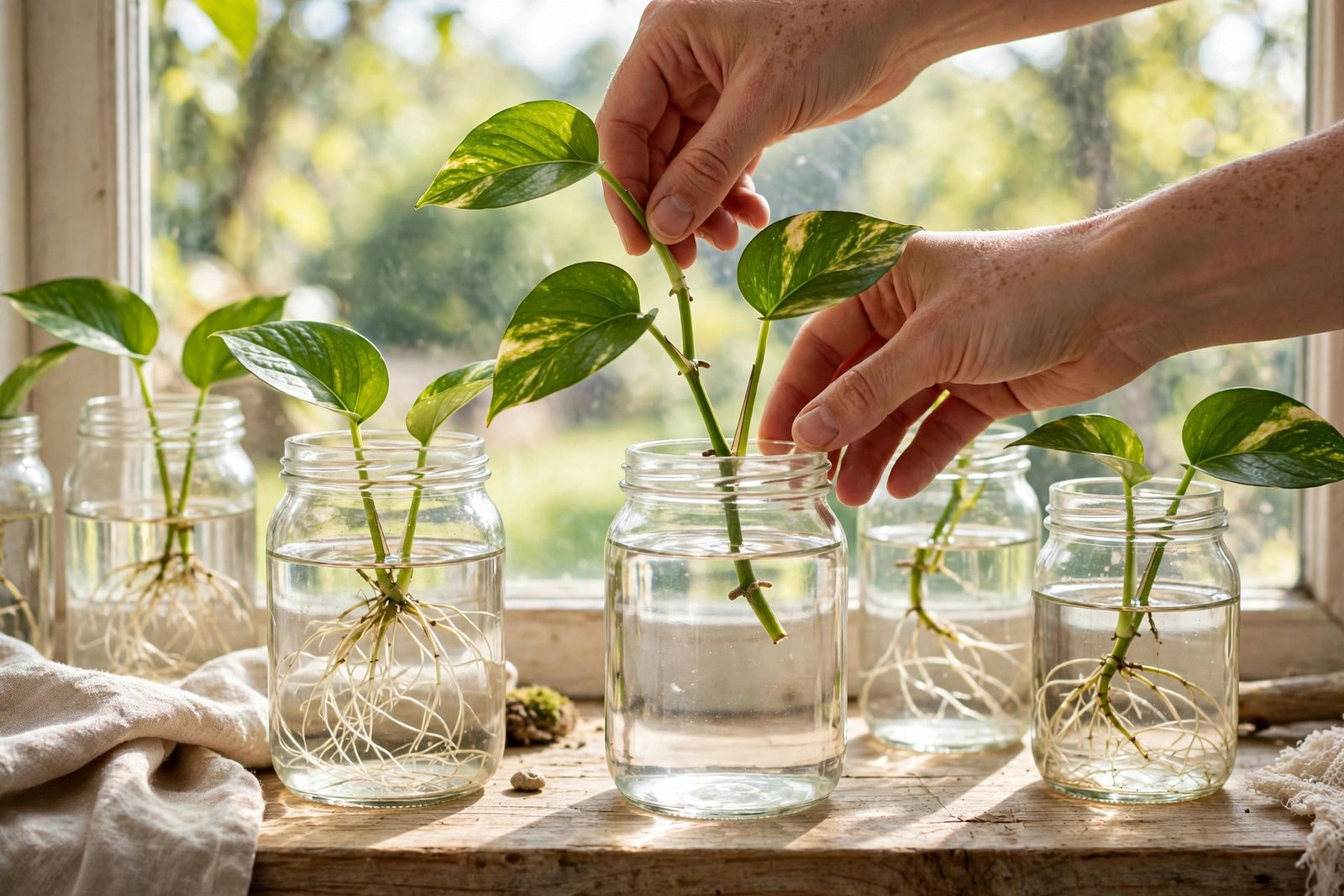
TL;DR
- The one rule: every cutting must include a node — the small bump on the stem where leaves and roots grow. No node, no roots, ever.
- Cut 4–6 inches just below a node with clean, sharp scissors. Strip any leaves that would sit underwater.
- Put the node in room-temperature water in a clear jar, in bright indirect light. Change the water every 5–7 days.
- Roots usually appear as tiny nubs in 7–14 days, but transplant-ready roots (2 inches or more, with side branches) take more like 3–4 weeks. Do not rush the move to soil.
- Pothos cuttings are toxic to cats and dogs, just like the parent plant. Keep jars out of pets’ reach.
I propagated my first pothos cutting because I had pruned a leggy vine and could not bear to throw the pieces away. I stuck them in a jam jar on the windowsill, and to my surprise, most rooted. Years and dozens of jars later, I can tell you pothos propagation is one of the easiest wins in houseplants — as long as you respect the node rule and the timeline. Everything else is patience.
What you need
- A healthy pothos vine (not a struggling one — stressed cuttings root poorly)
- Clean, sharp scissors or pruning shears
- A clear jar or glass (clear matters: you want to watch the roots)
- Room-temperature water (tap water left out overnight is fine)
- A spot with bright, indirect light
Rooting hormone is unnecessary for pothos — it roots readily without it, and hormone can cloud the water.
Step by step: taking and starting cuttings
1. Choose the right vine
Pick a healthy vine with firm, green leaves and no yellowing, pests, or mushy sections. A vine with several nodes gives you several cuttings, which is the whole point — one long vine can become three or four new plants.
2. Find the node
A node is the small bump on the stem where a leaf grows out, often with a tiny brown aerial root nub beside it. Run your finger along the stem and you will feel them. This is the most important step in the entire process: roots grow from nodes, and only from nodes. A cutting with leaves but no node will sit in water looking hopeful for weeks and never root. A cutting with a node and one healthy leaf will root happily.
3. Cut just below the node
Using clean scissors — wipe the blades with rubbing alcohol or hot soapy water first, because a dirty cut invites rot — cut about a quarter inch below a node, at a slight angle. Each cutting should be 4–6 inches long with two or three leaves and at least one node. If you are cutting a long vine into pieces, each piece needs its own node.
4. Strip the lower leaves
Remove any leaves that would sit below the waterline. Submerged leaves rot fast, and rotting leaves foul the water and can rot the cutting with them. Leaves above the water stay. If a cutting has only one leaf and it would be underwater, take a longer cutting or choose a different section.
5. Place in water
Put the cutting in the jar so the node is fully submerged and the leaves stay above water. Use room-temperature water, and fill enough to cover the node with a little to spare. A clear jar lets you watch progress.
6. Give it bright, indirect light
An east-facing windowsill, or a spot a few feet back from a brighter window, is perfect. Direct sun heats the water, encourages algae, and can scorch leaves — if your only bright spot is a south-facing sill, pull the jar back a foot or two.
7. Change the water every 5–7 days
Fresh water is the difference between clean white roots and a slimy jar. Every 5–7 days, pour out the old water, rinse the jar, and refill. While you are at it, check the cutting: a firm stem and a node swelling or showing white nubs means things are working.
The roots timeline: what actually happens, week by week
Guides that say “roots in 7–14 days” are not lying, exactly — but they are describing the first nubs, not a root system ready for soil. Here is the honest version:
| When | What you will see | What to do |
|---|---|---|
| Day 0 | Fresh cutting, node underwater, leaves perky | Bright indirect light, fresh water |
| Days 7–14 | Tiny white nubs pushing out of the node | Keep changing water weekly, do not move it |
| Days 14–21 | Roots lengthening to 0.5–1 inch, maybe branching | Same routine; still too early to transplant |
| Days 21–28 | Roots 2 inches or more, with side branches | Ready to transplant — or keep growing in water |
| Week 5+ | A full root mass filling the jar | Transplant soon, or start feeding lightly if keeping in water |
Temperature matters: cuttings root fastest at warm room temperatures, roughly 70–80°F. A cold winter windowsill slows everything by weeks, which is one more reason spring is propagation season.
The single most common beginner error is transplanting at day 10, when the first nubs appear. Those baby roots are fragile, and soil is a shock after water. Wait for 2-inch roots with branches. Your cutting will not mind the extra two weeks in the jar. It will mind being moved too early.
Moving cuttings to soil without shock
Water roots and soil roots are not quite the same — water roots are finer and used to constant moisture, so the transition needs a little care.
- Choose a small pot, 4 inches is plenty, with drainage holes and fresh, well-draining potting mix.
- Make a hole with your finger, settle the cutting in so the roots spread rather than bunching, and fill gently around them. Do not pack the soil hard.
- Water thoroughly until it drains, then empty the saucer.
- For the first two weeks, keep the soil a little more moist than you would for an established pothos — not soggy, just consistently lightly damp — while the roots adapt. Then switch to the normal routine: water only when the top 1–2 inches are dry, exactly as in How to Water Pothos Without Overwatering It.
- Expect a brief sulk. A cutting that droops for a few days after transplanting is adjusting, not dying. If it is still drooping after two weeks, check that the soil is not waterlogged and that the pot drains.
Keeping cuttings in water long-term
You do not have to transplant at all — pothos grows happily in water for months or years, and a jar of trailing cuttings looks wonderful. Two things change: change the water weekly without fail, and after the first month add a single drop of balanced liquid fertilizer monthly, since water has no nutrients and a cutting in plain water forever will eventually grow pale. Top up as water evaporates so roots stay submerged.
Troubleshooting
The stem went slimy or mushy. Usually a dirty cut, a submerged leaf, or water left unchanged too long. Trim back to firm, healthy stem with a clean cut, change the water, and start again with that cutting. If the whole cutting is mushy, discard it and take a fresh one from the parent plant.
No roots after three weeks. Check three things: is there actually a node underwater? Is the jar getting enough light? Is the room too cold? A node-less cutting will never root, however long you wait — that is the most common cause, and it is worth re-checking before anything else.
Roots grew, then the cutting yellowed. Sometimes the oldest leaf on a cutting yellows as the cutting redirects energy to roots. If the stem is firm and roots look healthy, this is usually fine — remove the yellow leaf and carry on. If the stem is soft, see the slime fix above.
Algae in the jar. Green film from too much direct sun. Move the jar to indirect light, rinse it out, and change the water. Algae rarely kills a cutting, but it competes for oxygen, so do not ignore it.
Cutting rooted beautifully, then died after transplanting. Almost always transplanted too early, or soil kept too wet afterward. Next time, wait for 2-inch branched roots, and keep the first two weeks lightly moist rather than soaked.
A quick note on pets
Pothos cuttings are toxic, just like the parent plant — the ASPCA lists pothos as toxic to cats and dogs, and every part, including cuttings, carries insoluble calcium oxalate crystals. A jar of cuttings on a low table is an invitation to a curious cat. Keep propagation jars somewhere pets genuinely cannot reach, sweep up fallen leaves, and call your vet immediately if a pet chews any part.
Common mistakes
- Taking cuttings without a node. Leaves alone do not root.
- Letting leaves sit underwater. They rot, and the rot spreads.
- Forgetting water changes. Weekly changes are the whole maintenance routine, and skipping them is how jars go slimy.
- Transplanting at the first sign of roots. Wait for 2 inches with branches.
- Using dull or dirty scissors. A crushed, ragged cut is an open door for rot.
- Putting jars in direct sun. Warm, algae-filled water and scorched leaves are the result.
Frequently asked questions
How long does it take for pothos cuttings to root in water?
First root nubs usually appear in 7–14 days, but transplant-ready roots — 2 inches or more with side branches — take about 3–4 weeks. Warmth, bright indirect light, and weekly water changes keep things on the faster end.
Can I propagate pothos from just a leaf?
No. A leaf without a node will not grow roots or a new plant, however long it sits in water. You need a stem section that includes at least one node. That node is where both roots and new growth come from.
Should I use rooting hormone for pothos?
You do not need it. Pothos roots readily in plain water. Hormone will not hurt, but it adds little and can cloud the water, so most growers skip it for this plant.
Can pothos live in water forever?
Yes, with weekly water changes and a monthly drop of liquid fertilizer after the first month. Growth will be slower than in soil, and leaves may stay smaller, but a water-grown pothos can thrive for years.
Why did my cutting rot in water?
The usual causes are a submerged leaf, a dirty or crushed cut, or water left unchanged for too long. Trim back to firm stem with clean scissors, remove any leaves below the waterline, and change the water every 5–7 days. If the whole cutting is mushy, start fresh with a new cutting from a healthy vine.