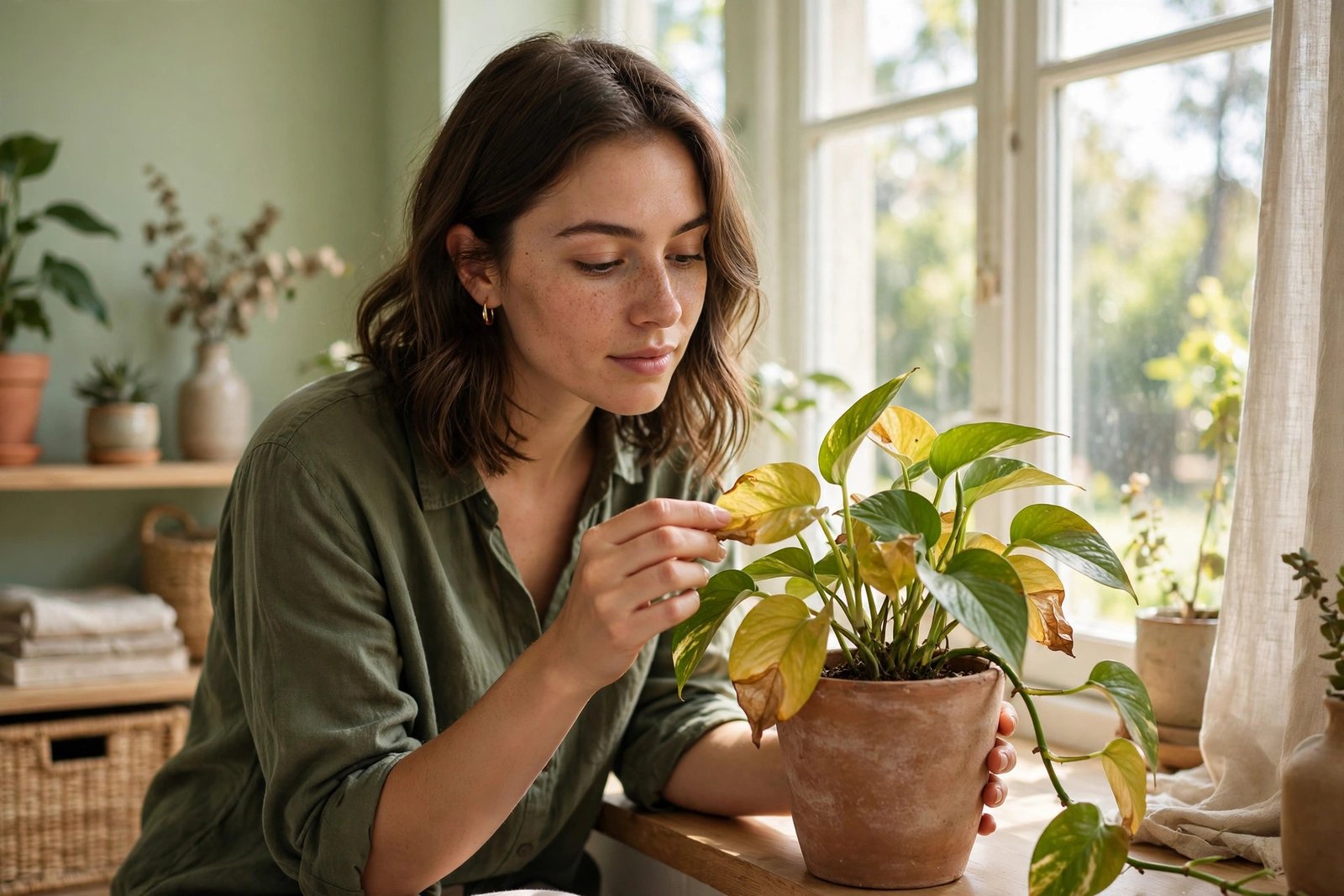
TL;DR
- Yellow leaves are a symptom, not a disease. The cause is almost always water, light, food, pests, or plain old age — and where the yellow shows up tells you which one.
- Do the 2-minute check first: which leaves are yellow, and is the soil damp or dry two inches down? That answer alone narrows it to one or two causes.
- Overwatering is the most common cause indoors. Soggy soil plus soft, yellow lower leaves means stop watering and let the plant dry out.
- Do not reach for fertilizer first. Feeding a stressed plant usually makes things worse.
- Yellow leaves that are already fully yellow will not turn green again. Judge recovery by the new growth, not the old leaves.
I still remember the first plant I nearly killed with kindness. It was a pothos on my kitchen windowsill, and I watered it every time I walked past it, because watering felt like caring. Within a month the lower leaves went soft and yellow, one after another, and I did exactly the wrong thing: I watered it more, then fed it, then moved it to a darker corner “to rest.” It took me far too long to learn that a yellow leaf is a message, and usually a simple one — if you read it before you react.
The 2-minute diagnosis
Before you touch anything, answer two questions.
1. Which leaves are yellow?
- Only the lowest, oldest leaves, one at a time, while everything else looks firm and green: probably natural aging. Normal. Skip to that section and relax.
- Lower leaves first, spreading upward, and the yellow leaves feel soft or mushy: think overwatering.
- Leaves all over going pale yellow-green, with small new growth: think light or food.
- Yellow with tiny speckles, fine webbing underneath, or sticky residue: think pests.
- Edges turning yellow or brown and crispy: think underwatering, dry air, or too much fertilizer.
2. Is the soil damp or dry two inches down?
Push your finger into the mix up to the second knuckle. Not the surface — the surface lies. Two inches down is where the roots live.
- Still damp days after watering, or the pot feels heavy: too much water, poor drainage, or both.
- Bone dry, and the pot feels light when you lift it: too little water.
- Moist but not wet, and the plant is still yellowing: look at light, food, or pests instead.
That is the whole diagnosis; the rest is the fix for whichever answer you got.
| What you see | Most likely cause | Fix |
|---|---|---|
| Lower leaves soft and yellow, soil damp | Overwatering | Let it dry out, check drainage |
| Leaves limp, crisp edges, soil bone dry | Underwatering | Soak thoroughly, then water on the finger test |
| Whole plant pale, small new leaves | Too little light | Move to brighter indirect light |
| Even yellowing of older leaves, no feed in a year | Hungry plant | Feed at half strength in growing season |
| Speckled yellow, fine webbing underneath | Spider mites | Isolate, wash leaves, treat |
| One lower leaf at a time, rest healthy | Natural aging | Nothing — remove the leaf if you like |
Cause 1: Overwatering (the usual suspect)
Overwatering does not mean you poured too much water once. It means the roots have been sitting wet for too long, and roots need air as much as they need water. Wet soil pushes the air out, roots suffocate, and the plant starts dropping its lowest leaves first, soft and yellow.
The fix is boring, and that is why it works. Stop watering. Let the top two inches of soil dry out before you water again, and always empty the saucer so the pot is never standing in water. Check that the pot actually has drainage holes — a beautiful pot with no holes is a plant trap. If the soil smells sour or the stems feel mushy at the base, the roots may already be rotting. In that case, take the plant out, trim any black, mushy roots with clean scissors, and repot into fresh, well-draining mix. Do not feed it while it recovers.
If watering discipline is your weak spot, the routine in How to Water Pothos Without Overwatering It is worth reading even if your plant is not a pothos — the finger test and the soak-and-drain method are the same for almost every houseplant.
Cause 2: Underwatering
Underwatering looks different. The leaves go limp first, then yellow from the edges inward, and the edges turn dry and crispy. The soil pulls away from the sides of the pot, and the whole pot feels suspiciously light.
The fix is a proper soak, not a timid sip. Water slowly until it drains freely, wait ten minutes, then water once more so the whole root ball gets wet — very dry soil repels water at first, and a quick pour just runs down the sides. Then go back to checking the soil before every watering, rather than watering on a calendar. A plant that dried out once will usually bounce back within a week or two. Leaves that went fully crispy will not recover, but new growth will tell you the plant forgave you.
Cause 3: Not enough light
A plant in too little light cannot make enough food to support all its leaves, so it sacrifices the oldest ones first. The whole plant fades to a pale yellow-green, new leaves come in small, and growth slows to almost nothing. People often blame water for this one, and then overwater a plant that was actually just hungry for light.
Move it to brighter indirect light — near an east window, or a few feet back from a bright south or west window. Avoid throwing it straight into harsh afternoon sun, which scorches leaves and creates a second problem. Give it two to three weeks; light fixes are slow, but they are real.
Cause 4: The plant is hungry
If a plant has not been fed in a year or more and its older leaves are yellowing evenly, it may simply be out of nutrients, usually nitrogen first. This is the one case where fertilizer actually helps — but gently. Use a balanced liquid houseplant fertilizer at half the strength on the label, only during spring and summer when the plant is actively growing, and only on soil that is already moist. Never feed a dry plant, a stressed plant, or a plant in winter dormancy and expect a miracle. If you have fed heavily and leaf edges are yellowing and browning, that is fertilizer burn: flush the soil with plain water until it drains freely, and skip feeding for two months.
Cause 5: Pests, especially spider mites
Pests cause a different kind of yellow: speckled, mottled, or stippled, often with fine webbing on the undersides of leaves or tiny dots that move when you look closely. Spider mites love dry indoor air, and they are easy to miss until the damage is obvious.
Isolate the plant from your others immediately. Wash the leaves, top and undersides, with a firm stream of water or a damp cloth — that alone removes a large share of mites. Repeat every few days for two weeks, because eggs keep hatching. If the problem persists, an insecticidal soap made for houseplants is the next step, used exactly as the label says. Check your other plants too. Mites travel.
Cause 6: The ones people miss
Natural aging. One lower leaf yellowing at a time, while new growth looks healthy, is just the plant retiring old leaves. Do nothing — snip the yellow leaf off for looks if you like.
Rootbound. If roots are circling the pot, poking out of the drainage holes, and water runs straight through without wetting the soil, the plant cannot take up water or food properly, and leaves yellow all over. Repot into a pot only one or two inches wider, with fresh mix.
Temperature shock. A blast of cold air from a winter window, or a plant sitting right over a heating vent, can yellow leaves fast. Move it somewhere with stable temperatures and no direct drafts.
If your yellowing plant is a monstera, its own care guide covers the monstera-specific version of all of this — light for fenestrations, support, and the watering rhythm that keeps its leaves green: How to Care for Monstera Deliciosa (Light, Water, Support).
What not to do in a panic
- Do not fertilize a stressed plant. Food is not medicine.
- Do not repot unless you have a real reason, like rot or a rootbound pot. Repotting is surgery, and a stressed plant does not need surgery on top of everything else.
- Do not move the plant to three different spots in one week. Plants need time to respond, and you need time to see which change helped.
Common mistakes
- Watering on a schedule instead of checking the soil. Your home is not a greenhouse with fixed conditions, and neither is anyone else’s.
- Judging recovery by old leaves. Fully yellow leaves do not re-green. Watch the new growth.
- Removing every yellow leaf the moment it appears. A half-yellow leaf is still photosynthesizing a little, and the pattern of which leaves yellow is diagnostic information. Wait until a leaf is fully yellow and loose before removing it.
Frequently asked questions
Should I cut off yellow leaves?
Yes, once a leaf is fully yellow and comes away easily. Use clean scissors and cut near the base of the leaf stem. Do not cut a leaf that is only partly yellow — it is still feeding the plant a little.
Will yellow leaves turn green again?
No. Once a leaf has lost its chlorophyll and gone fully yellow, it will not re-green. Recovery shows up as healthy new growth, not repaired old leaves.
Is it overwatering or underwatering?
Check the soil two inches down and feel the yellow leaves. Damp soil plus soft, mushy yellow leaves points to overwatering. Dry soil plus limp leaves with crispy edges points to underwatering. When in doubt, the finger test beats any schedule.
Can yellow leaves mean my plant is dying?
Not usually. Most yellowing is a care imbalance — water, light, or food — and most plants recover once the imbalance is fixed. Real danger signs are mushy stems at the base, sour-smelling soil, or all leaves yellowing and dropping fast — those need immediate root inspection.
Do I need to repot a plant with yellow leaves?
Usually no. Repot only if the plant is rootbound, the soil stays soggy for days, or you find rotted roots. Otherwise, fix water and light first and give the plant a few weeks. Repotting a stressed plant often adds shock to an already stressed plant.