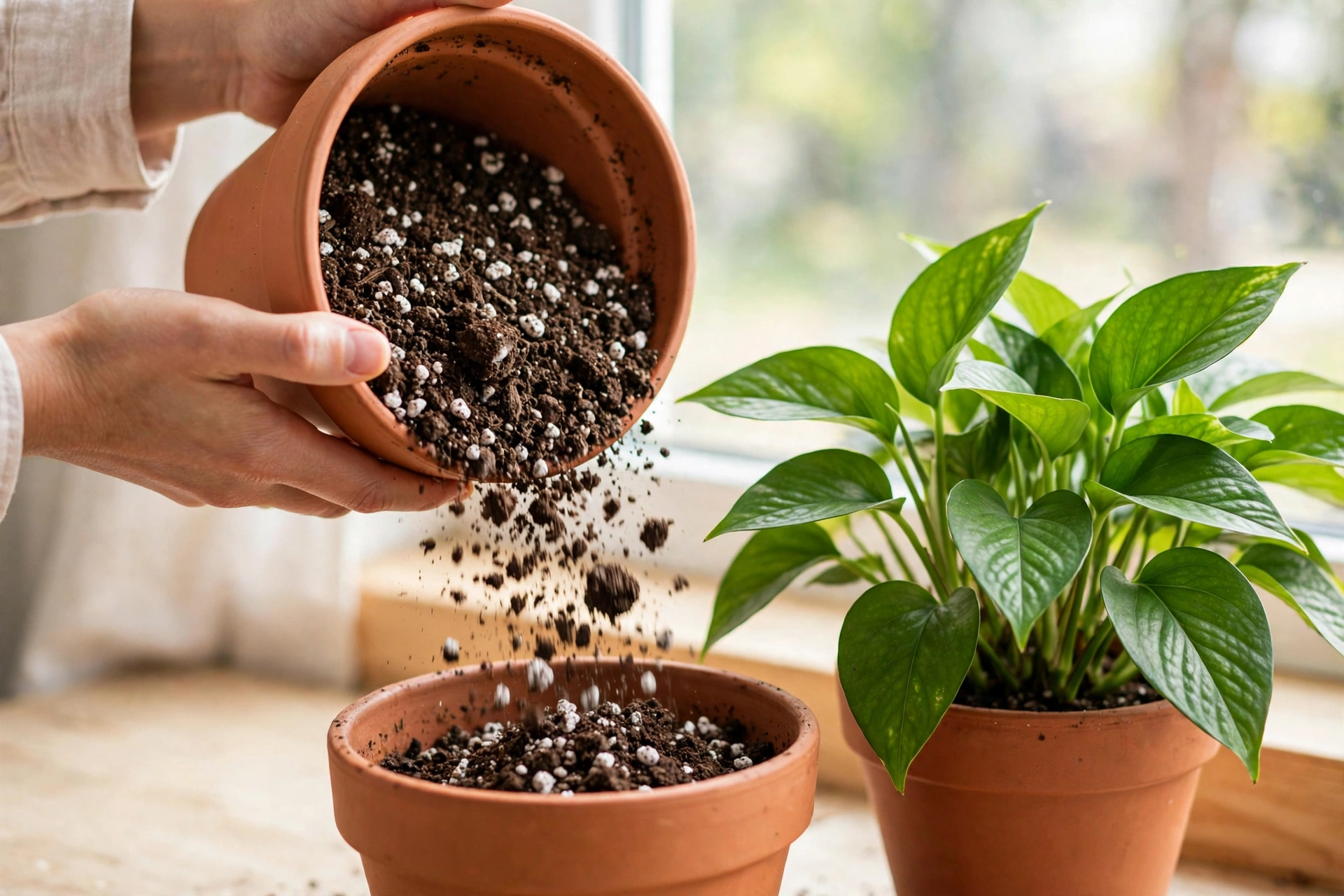
TL;DR: Good indoor soil does three jobs at once: it drains fast enough that roots never sit in water, holds enough moisture that you are not watering daily, and stays airy so roots can breathe. The simplest mix that does all three is 2 parts coconut coir (or peat-based potting mix) + 1 part perlite + ½ part worm castings or compost. Never use garden soil in pots, always use a pot with a drainage hole, and refresh the mix every year or two as it breaks down.
WHAT GOOD SOIL ACTUALLY DOES
Soil is not just something to hold a plant upright. Underground, it controls almost everything your plant experiences: how much water reaches the roots, how much air gets to them, and how steadily nutrients arrive. Get the mix wrong and even perfect watering and light cannot save the plant — soggy soil rots roots, while a mix that dries to dust starves them. The balance you want is sometimes called “moist but airy.” After watering, the mix should feel damp like a wrung-out sponge, not dripping wet, and it should dry out at a steady pace over days, not hours. The secret is pore space: tiny gaps between particles that hold water, and larger gaps that hold air. Perlite, bark, and coarse materials create the air gaps. Coir and peat hold the water. Compost and worm castings feed the plant slowly. Garden soil fails indoors because it has almost no structure in a pot. Outside, worms and weather keep it open. In a container it compacts into a brick that stays wet at the bottom and dry on top — the exact recipe for root rot. If you take one rule from this guide, take that one: garden soil stays outside.
THE ALL-PURPOSE RECIPE (WORKS FOR MOST HOUSEPLANTS)
You need a bucket, a measuring cup (any container works as your “part”), and three ingredients from a garden centre: 2 parts coconut coir or peat-based potting mix — the moisture-holding base. Coir rewets better than peat when it dries out, and it lasts longer before breaking down. 1 part perlite — the white, popcorn-like bits that keep the mix light and full of air gaps. Perlite never breaks down, so it keeps working for years. ½ part worm castings or compost — gentle, slow-release nutrition. Worm castings are hard to overdo and seedlings love them. Mix them dry in the bucket until evenly blended, then water the mix lightly before potting — dry coir can be dusty and slow to absorb at first. Pot your plant, water thoroughly until it drains, and you are done. This mix suits pothos, philodendrons, monsteras, spider plants, peace lilies, and most common tropical foliage plants. If your plant prefers slightly drier conditions, add an extra ½ part perlite. This is also the mix behind the routine in our beginner houseplant care guide — good soil makes the finger test from our how often to water guide far more forgiving, because the mix dries at a predictable pace instead of staying soggy.
MIXES FOR SPECIAL PLANTS
Succulents and cacti. They need the fastest drainage of all: 1 part standard potting mix or coir + 1 part pumice or perlite + ½ part coarse horticultural sand. The mix should dry out completely within a day or two of watering. Use coarse sand only — fine beach or play sand fills the air gaps and makes drainage worse, not better.
Aroids (monstera, philodendron, anthurium, alocasia). These forest-floor plants want a chunky mix with big air pockets: 2 parts fine orchid bark + 2 parts coconut coir + 2 parts perlite + ½ part worm castings, with a handful of horticultural charcoal if you have it. Our monstera care guide explains why chunk matters for that plant in particular — its thick roots rot quickly in dense, wet soil.
Ferns and calatheas. The thirsty exceptions: 3 parts coconut coir + 1 part perlite, kept lightly moist. These plants wilt fast if they dry out completely, so a moisture-holding mix suits them — but it still needs that perlite, and it still needs a drainage hole.
BAGGED MIX VS DIY: WHAT TO BUY, WHAT TO AVOID
A decent bagged indoor potting mix is fine for most people — look for one that lists coir or peat plus perlite on the bag, feels light and fluffy when you open it, and does not smell sour. Avoid bags that feel heavy and dense, or that are mostly fine peat dust: they compact fast and go hydrophobic (water runs off instead of soaking in) once they dry out. DIY wins on two counts: it is much cheaper once you have the ingredients, and you can tune it per plant instead of buying a separate specialty bag for each one. A bag of coir, a bag of perlite, and a bag of worm castings cover nearly every houseplant you will ever own. If you want a deeper recipe chart for every plant type, this potting soil mix guide is a solid reference. Whichever route you take, two rules still apply: a drainage hole is non-negotiable, and a layer of stones at the bottom of the pot does NOT replace drainage — it just raises the soggy layer closer to the roots.
WHEN TO REFRESH THE MIX
Potting mix is not forever. Coir and peat break down over 1–2 years, bark over 2–4 years, and as they break down the air gaps collapse and the mix stays wet longer. Signs it is time: water sits on the surface instead of soaking in, the mix smells sour, growth has stalled despite good light and watering, or you see a white salty crust on the surface. Refresh by repotting into fresh mix, gently shaking off the old mix from the outer roots (no need to bare-root the plant completely). Spring is the best time, just as growth picks up. And while you are at it, only move up one pot size — a huge pot holds far more wet mix than the roots can drink, which brings back the rot problem you just fixed.
COMMON MISTAKES
Using garden soil indoors. It compacts, stays wet, and brings pests and weed seeds with it. Always use a potting mix. No drainage hole. The prettiest pot in the shop is a trap without one. Use it as a cover pot with a nursery pot inside. Potting into a giant pot “to grow into.” Roots cannot drink that much water. Size up gradually, one step at a time. Adding sand to heavy soil. Fine sand plus dense soil makes something like concrete. Drainage comes from perlite, bark, and pumice — not sand. Never refreshing the mix. A plant that slowly declines after two good years often just needs fresh, airy mix, not more fertilizer.
FREQUENTLY ASKED QUESTIONS
Can I use regular garden soil for indoor plants?
No. Garden soil compacts in containers, stays wet at the bottom, and often carries pests and weed seeds. Use a potting mix made for containers — coir or peat plus perlite — which stays light and airy in a pot.
What is the best soil mix for most houseplants?
Two parts coconut coir or peat-based potting mix, one part perlite, and half a part worm castings or compost. It drains well, holds moisture, and feeds gently. Add extra perlite for plants that prefer drier conditions.
How do I know if my plant’s soil is bad?
Water sitting on the surface, a sour smell, white salty crust, or growth stalling despite good light and watering all point to broken-down mix. Repot into fresh mix, ideally in spring.
Should I put rocks at the bottom of the pot for drainage?
No. A rock layer does not improve drainage — it just moves the soggy zone higher, closer to the roots. A drainage hole and an airy mix are what actually work.
How often should I change my houseplant’s soil?
Roughly every 1–2 years for most mixes, or when you see the warning signs above. Succulent mixes last longer; bark-heavy aroid mixes need refreshing every 2 years or so as the bark breaks down.